
Half-Kelly sizing and the limits of an estimated edge
A high win rate does not tell you whether a strategy makes money. Payoff sizes, losses, fees, and exposure matter too. Kelly sizing is one way to connect an estimated edge to an allocation; it is not evidence that the edge exists.
The mathematics of compounding
A gain of 50% followed by a loss of 50% leaves 75% of the starting balance. That arithmetic example illustrates compounding; it does not establish that a particular sizing method will outperform another.
Fixed cash size, a fixed fraction of equity, volatility targeting, and Kelly sizing are different policies. Comparing them requires the same trade sequence, costs, constraints, and out-of-sample evaluation.
What the Kelly fraction assumes
For a simplified binary bet with win probability p, loss probability q = 1 − p, and net payoff odds b, the log-growth optimum is:
f* = (p · b − q) / bBinary-bet model with known probabilities and payoffs. Market returns require a richer model and separate constraints.Real trading inputs are estimates. An overstated edge can produce excessive exposure. There is no universal estimation-error percentage at which every strategy enters a “ruin zone.”
Fractional sizing and estimation risk
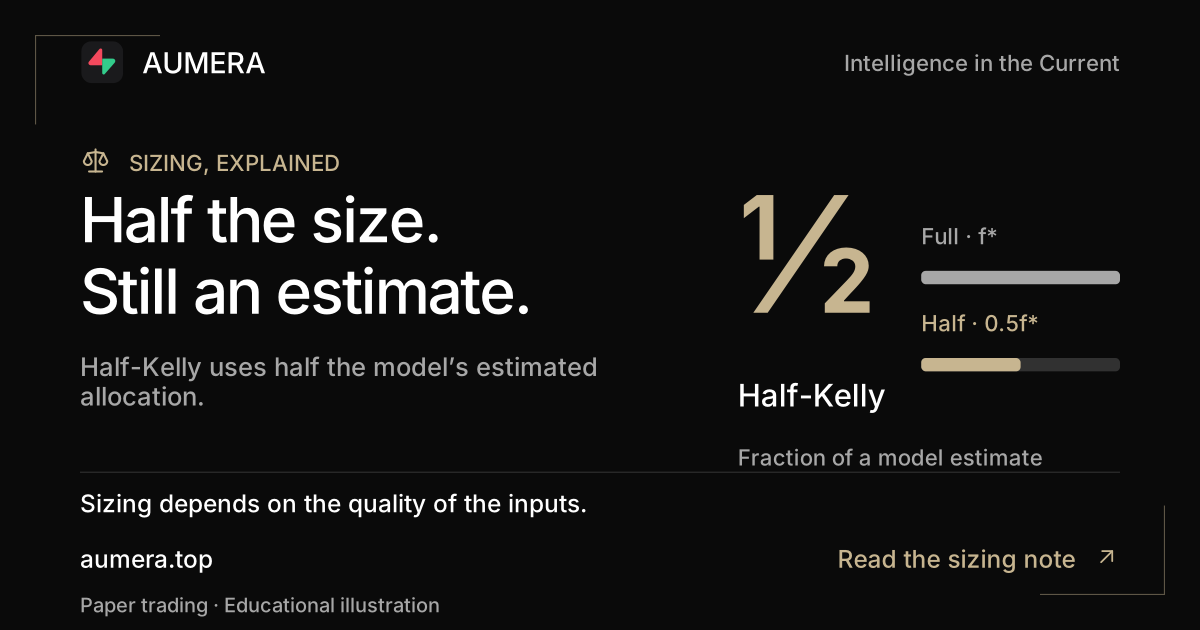
Half-Kelly takes 0.5 · f* of the modeled full-Kelly allocation. This lowers exposure in that model. It does not guarantee a fixed share of optimal growth, a fixed variance reduction, or a fixed drawdown probability.
Research on risk-constrained Kelly allocation treats growth and drawdown risk as separate objectives. Distributionally robust Kelly research addresses uncertainty in the assumed outcomes. Neither establishes AUMERA strategy performance.
How this relates to AUMERA
AUMERA keeps research proposals separate from paper admission, allocation, and protective exits. A reference sizing policy does not establish that every active paper strategy uses that policy. Current strategy configuration and recorded decisions determine the actual behavior.
Members can inspect available decisions in Risk & controls. Advisory confidence is not a measured win probability. Paper results and after-cost validation remain separate evidence.