
Reading order-book depth without overstating the evidence
An order book adds context to a price chart. To use it responsibly, distinguish the displayed observation from the explanation you infer.
A heatmap is a model
A liquidation heatmap may estimate where leveraged positions could be closed. Its levels depend on the provider’s inputs and assumptions. A highlighted band does not guarantee a bounce, a sweep, or an executable fill.
What depth can and cannot establish
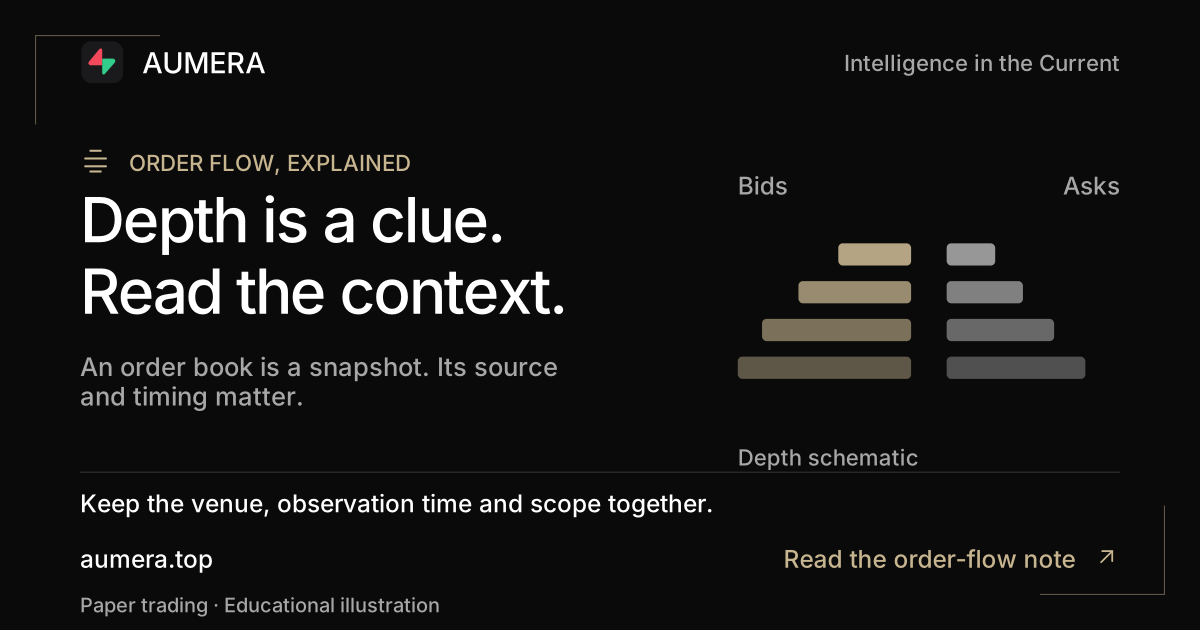
Qualified public L2 observations can show visible prices and aggregated quantities. Spread and imbalance must retain their venue, symbol, acquisition time, and units.
A snapshot cannot establish how long an individual order has rested, whether its owner is an institution, or whether it was placed with manipulative intent. There is no universal 5-second or sub-second boundary that proves those conclusions.
Spread should be evaluated alongside the proposal’s expected payoff, size, fees, and exit costs. A single basis-point threshold is not a universal profitability boundary.
Interpretation needs a sequence
Claims about absorption require an explicit method and a time sequence of qualified observations. Trade-flow measures also need actual trade data; they cannot be reconstructed from a solitary depth snapshot.
AUMERA’s public-depth qualification is distinct from certification of order-level queue history or sub-second execution quality. Unavailable inputs must remain unavailable.
Inspect the source and the scope
In the member Trading Desk, inspect the source labels on available depth. In Markets 360, cross-asset reference scenarios are labeled separately from connected crypto prices.
Paper fills, research interpretations, and observed market data serve different purposes. Keeping those scopes visible makes a decision easier to review.